
1. Overview & Botany
Alkanet is a perennial herb belonging to the Boraginaceae (Borage) family.
-
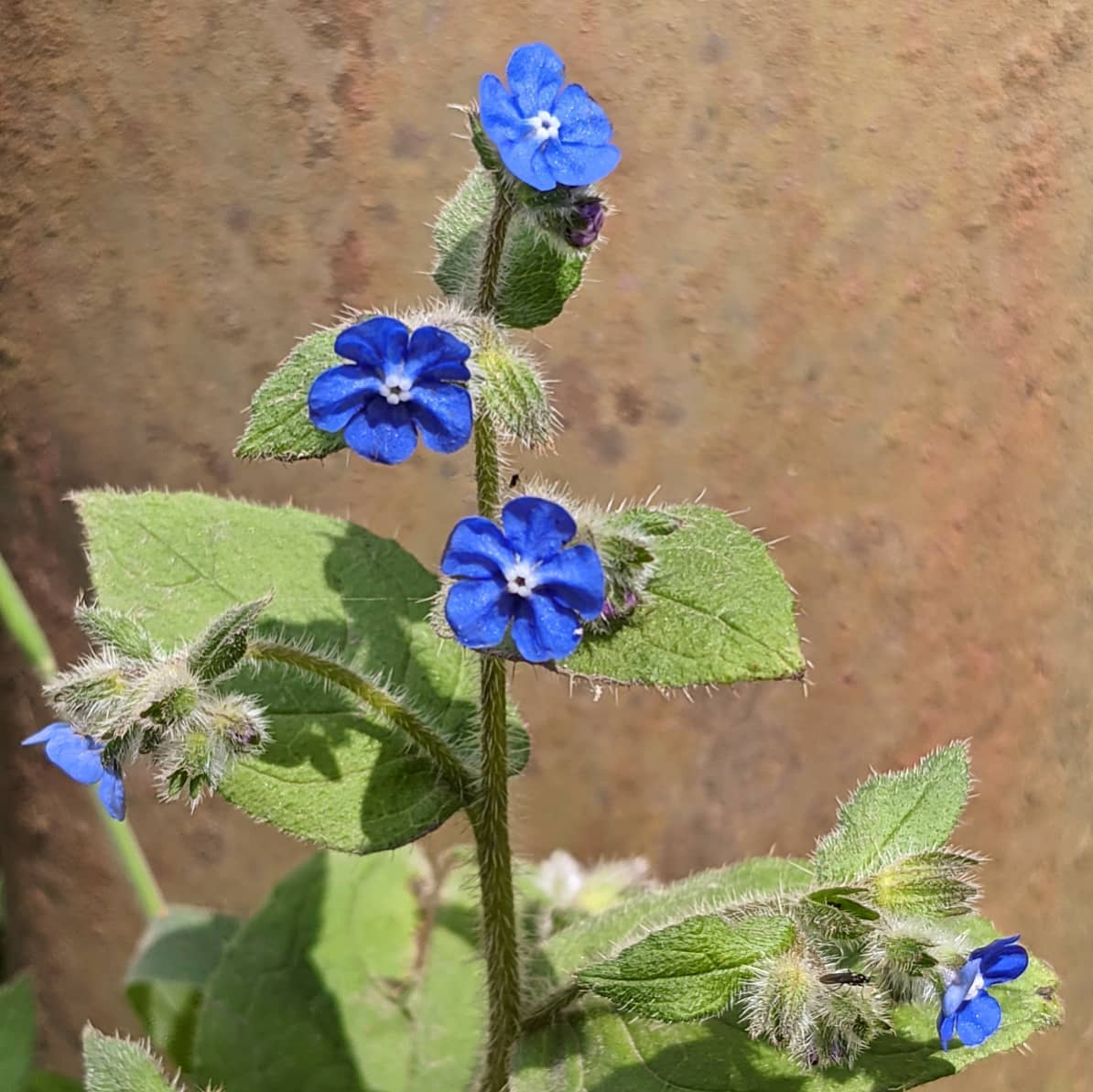
The Plant: It grows to about 12 inches high, featuring rough, bristly leaves and small, striking blue flowers with white centers.
-
The Root: The prize is the thick, dark-red taproot. While the exterior is blackish and scaly, the interior is blue-red with a whitish core.
-
The Chemistry: The primary coloring agent is Alkannin ($C_{16}H_{16}O_{5}$), a fat-soluble naphthoquinone pigment. It is famous for being insoluble in water but highly soluble in oils, alcohol, and ether.
2. History
Alkanet has been a tool of artisans for over 2,000 years.
-
Ancient Egypt & Rome: Used as a cosmetic rouge and a textile dye. The Greek physician Dioscorides documented its medicinal properties in his 1st-century encyclopedia, De Materia Medica.
-
The Middle Ages: In Medieval England, the term “Alkanet” specifically referred to this plant. It was used to color “low-quality” wines to make them look like expensive, aged reds.
-
Gunsmithing Tradition: Since the 1800s, British gunsmiths have used “Alkanet Oil” to give high-end walnut stocks a deep, reddish “hue” that accentuates the wood grain.
3. Varieties
While $Alkanna$ $tinctoria$ is the “true” dyer’s alkanet, several relatives share the name:
-
Dyer’s Alkanet ($Alkanna$ $tinctoria$): The primary source of red dye.
-
Green Alkanet ($Pentaglottis$ $sempervirens$): Often found as a garden weed; its flowers are edible, but it lacks the potent red dye in the root.
-
False Alkanet ($Anchusa$ $officinalis$): Also used for dye but considered inferior in color depth.
4. Places of Cultivation
Alkanet thrives in sandy, well-drained soils and temperate to Mediterranean climates.
-
Native Regions: Mediterranean basin, Southern Europe, North Africa, and parts of Western Asia.
-
Major Producers: Currently cultivated or wild-harvested in Hungary, France, and India. In India, it is famously known as Ratan Jot and is a key ingredient in Kashmiri cuisine.
5. Market & Commercial Uses
-
Cosmetics: A popular natural colorant for lip balms, rouges, and soaps.
-
Culinary: Essential for the red color of Rogan Josh (lamb curry). In the EU, its use as food dye (E103) was withdrawn due to safety concerns, but it remains popular in traditional Asian cooking.
-
Textiles & Wood: Used to dye silk and wool (mordanted with alum) and as a stain for fine wood instruments like violins.
-
Chemical Indicator: Because it turns blue in alkaline environments and red in acidic ones, it is used in some pH-indicator papers (Anchusin paper).
6. Health Benefits & Side Effects
Safety Warning: Alkanet contains Pyrrolizidine Alkaloids (PAs), which can be toxic to the liver.
-
Traditional Benefits: Historically used topically for wound healing, skin inflammations, and as an astringent.
-
Modern View: Internal consumption is discouraged in many Western countries due to potential liver damage (hepatotoxicity) if used in high doses or over long periods.
-
Topical Safety: Generally considered safe in cosmetics when used at concentrations below 2%.
7. Business Opportunities
-
Organic Cosmetics: There is a growing “Clean Beauty” niche for Alkanet as a vegan alternative to Carmine (which is made from insects).
-
Sustainable Dyeing: Artisanal textile brands are increasingly seeking Alkanet for “slow fashion” natural dyeing.
-
PA-Free Extraction: A major business opportunity lies in developing technology to extract the red pigment (Alkannin) while filtering out the toxic Pyrrolizidine Alkaloids, creating a “safe-grade” global food colorant.
1. Primary Cultivation States in India
In India, “Ratan Jot” is predominantly harvested from the wild or cultivated in the following regions:
-
Ladakh & Himachal Pradesh: * Specific Areas: Lahaul, Spiti, and the cold desert regions of Ladakh.
-
Variety: This is the high-altitude variety (Arnebia euchroma), found at elevations of 3,000 to 4,500 meters. It is a major source of the high-quality red pigment used in Tibetan and Ayurvedic traditions.
-
-
Jammu & Kashmir: * Specific Areas: The higher reaches of the Kashmir Valley.
-
Usage: Historically gathered for the culinary industry to provide the deep red color to the famous Rogan Josh.
-
-
Rajasthan & Gujarat:
-
Specific Areas: Semi-arid districts like Udaipur, Pratapgarh, and Banswara.
-
Note: In these states, the name is sometimes also associated with Jatropha curcas (Wild Castor), which is grown for biodiesel. However, true dyer’s alkanet (Alkanna tinctoria) prefers the sandy, alkaline soils found in parts of the Thar desert.
-
-
Uttar Pradesh:
-
Specific Areas: Regions ranging from Jhansi to Varanasi. Small-scale cultivation and trade hubs are concentrated here for the herbal market.
-
-
Other States: Small pockets of cultivation and wild harvesting exist in Bihar, Jharkhand, and Uttarakhand.
2. Global Cultivation Areas
Alkanet is native to the Mediterranean region and thrives in sandy, maritime environments.
-
Mediterranean Basin: Southern France, Spain, Italy, and Greece.
-
North Africa: Morocco, Tunisia, and Egypt.
-
West Asia: Turkey, Syria, Israel, and reaching into parts of Afghanistan.
-
Central & Southern Europe: Hungary and Slovakia are significant commercial producers for the European natural dye and textile industries.
3. Ideal Growing Conditions (Summary)
If you are considering the business of cultivating Alkanet, the following environmental factors are critical:
-
Soil: It strictly “dislikes” acid soils. It requires alkaline, sandy, or well-drained loamy soil.
-
Climate: Very drought-tolerant. It thrives in full sunlight and hot, dry positions once established.
-
Elevation: For Himalayan varieties, high altitude is necessary; for Mediterranean varieties, low-lying coastal or sandy plains are ideal.
4. Trade Hubs (Mandi)
If you are looking for the commercial side, the following Indian cities are major centers for the trading of Alkanet roots:
-
New Delhi: Khari Baoli (Asia’s largest spice and herb market).
-
Ahmedabad: Major hub for sourcing from Rajasthan and Gujarat.
-
Amritsar: Significant for Himalayan and imported Afghan varieties.
When discussing the varieties of Alkanet, it is important to distinguish between the “True Alkanet” used for dyes and several related species that share the name or are used as substitutes in different parts of the world.
In the trade of botanicals, “Alkanet” is often a “group name” for plants in the Boraginaceae family that produce a red pigment in their roots.
1. True Alkanet (Alkanna tinctoria)
This is the most famous and commercially significant variety, primarily used in the European and Mediterranean markets.
-
Characteristics: A low-growing perennial with hairy leaves and small blue/purple flowers.
-
Root Quality: Contains the highest concentration of Alkannin, a fat-soluble red dye.
-
Primary Use: High-end cosmetics (lip balms, rouges), wood stains (for violins and antique furniture), and coloring fine wines.
2. Himalayan Alkanet / Ratan Jot (Arnebia euchroma)
In the Indian and Tibetan markets, this is the dominant “variety.” It is native to the high-altitude cold deserts of the Himalayas.
-
Characteristics: Extremely hardy, found at altitudes between 3,000m and 4,500m.
-
Root Quality: The root is much thicker and more fibrous than the European variety. It provides a deep purple-red hue.
-
Primary Use: Traditional medicine, the famous red color in Rogan Josh curry, and Tibetan hair oils.
3. Green Alkanet (Pentaglottis sempervirens)
Often found growing wild in the UK and Western Europe, this variety is frequently mistaken for the dyer’s alkanet.
-
Characteristics: It has large, bristly leaves and very bright blue flowers that look like Forget-me-nots.
-
Root Quality: Poor. It does not contain enough pigment for commercial dyeing.
-
Primary Use: Mostly considered a garden ornamental or a weed. The flowers are sometimes used as an edible garnish in salads.
4. False Alkanet / Common Bugloss (Anchusa officinalis)
Found throughout Europe and North America, it is often used as a substitute for true alkanet in herbalism.
-
Characteristics: Taller than Alkanna tinctoria, with intense blue or purple flowers.
-
Root Quality: Moderate. It contains some red pigment but is less potent than the true variety.
-
Primary Use: Historically used in traditional folk medicine, though it contains alkaloids that require caution.
5. Yellow Alkanet (Lithospermum officinale)
Also known as Gromwell, this is a distant relative sometimes grouped under the alkanet name in older botanical texts.
-
Characteristics: Produces yellowish-white flowers and very hard, nut-like seeds.
-
Root Quality: The root contains Shikonin (chemically similar to Alkannin).
-
Primary Use: Extremely popular in Japanese and Chinese traditional medicine (known as Zicao) for skin conditions.
Summary Table for Business/Selection
-
-
